


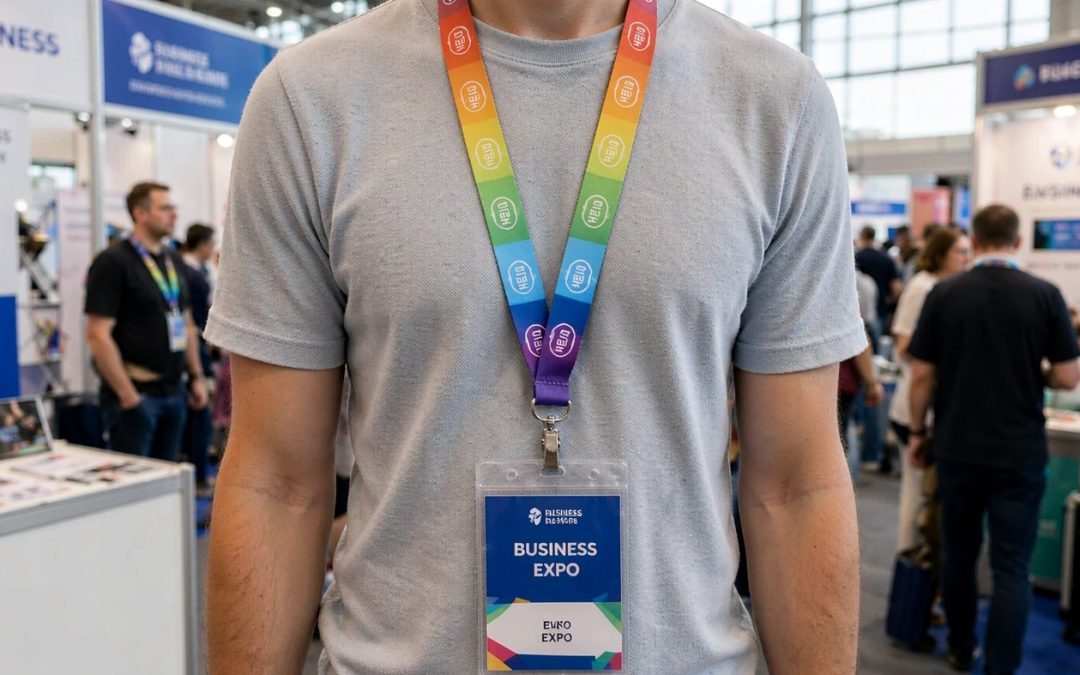
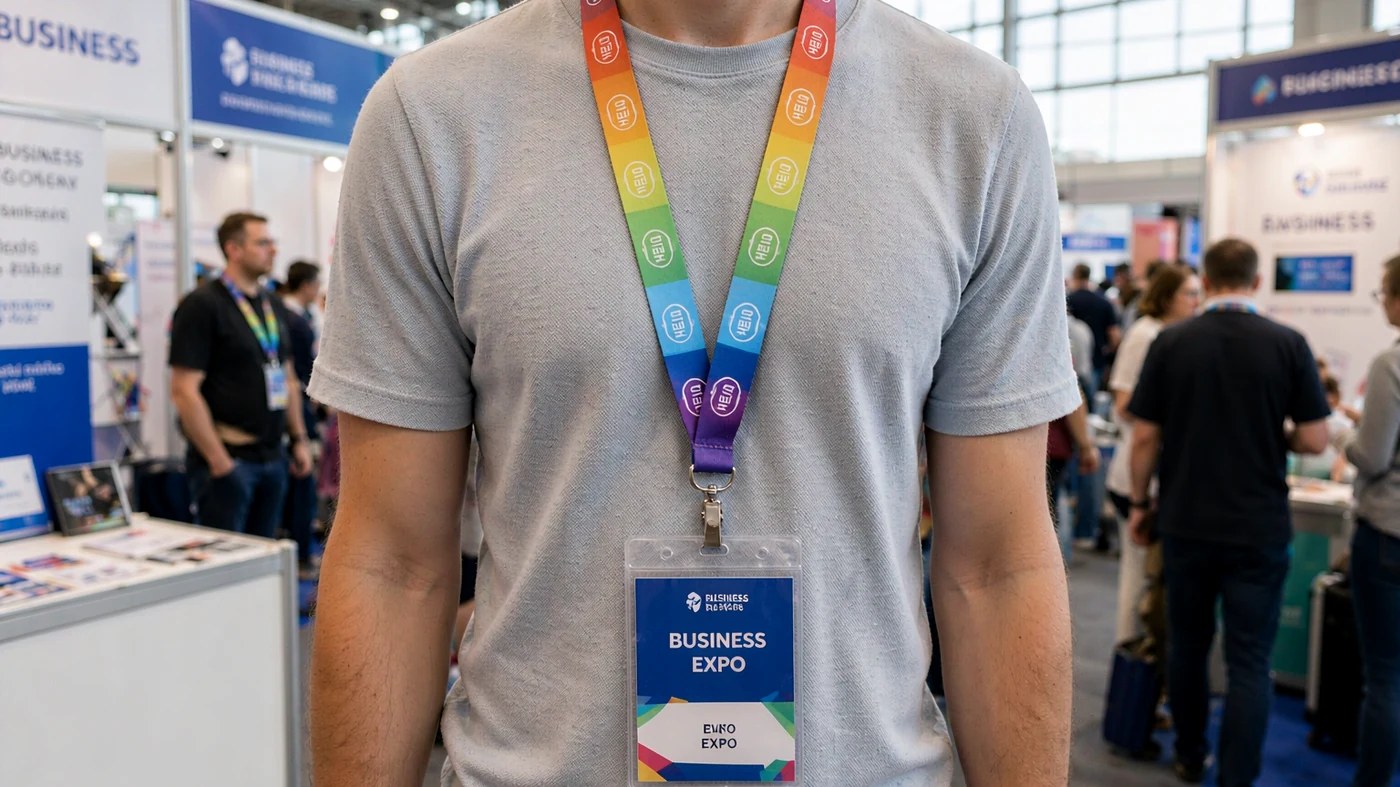
Yes—custom lanyards are worth it when visible role labels, branding, or a keepsake matter enough to justify the extra cost over a comparable blank option. Even a one-day event can qualify. If you only need to carry a badge and nobody needs to read the strap, a blank lanyard or clip may be the better buy.
The decision comes down to three checks: what customization adds, the delivered cost for the quantity you will actually use, and whether the finished design works with your badges. A lower unit price alone does not make a larger order worthwhile.
When custom lanyards are worth it
- Event teams need readable STAFF, VOLUNTEER, PRESS, or EXHIBITOR labels.
- A school, office, or club wants a consistent identity across repeated use, where neck-worn straps are permitted.
- A sponsor or organizer has a specific reason to put its name on the strap, rather than only on the badge.
- The design has keepsake value for attendees or members, even if the event happens only once.
Compare custom lanyards with a blank option using the same quantity, width, attachments, and delivery requirements. Ask what the extra spend buys in your situation—not just whether the custom version looks more finished.
What customization adds—and what it does not
Role identification
A readable role label gives visitors another way to find staff in a crowd. For example, an event with several volunteer teams could use short role names rather than a detailed logo. A strap is only a visual cue, not proof of identity or authorization; check credentials separately where access is controlled.
Keep personal details on custom ID cards in compatible ID card holders. Check the complete set while worn: a clear strap label does not fix a badge that turns backward.
Branding and keepsakes
Customization puts a name or design on the strap itself. For multicolor artwork, compare dye-sublimation lanyards with the supplier’s other print options. For simple lettering, compare proofs on polyester or nylon lanyards. Confirm the actual webbing composition and print process for the quoted product; a product-family name does not establish every material specification.
If you prefer woven lanyards, inspect the smallest lettering on a finished sample rather than assuming the artwork will reproduce identically across methods. Coordinate the design with event badges if the set is intended as a keepsake. Later reuse is possible, but do not budget on guaranteed retention, impressions, or sales.
Carrying and attachment choices
Hands-free carrying is a lanyard benefit, not a reason by itself to pay for customization. Flat straps and tubular lanyards still need to be compared for fit and comfort with your actual badge. Where users repeatedly present a card to a reader, a compatible reel may matter more than strap printing; compare badge reel options before allocating the budget.
Safety suitability
Neither a printed logo nor a breakaway label proves that a neck-worn strap is suitable for a particular user or setting. For children, confirm the institution’s policy before ordering; that policy may rule out neck straps. In machinery areas, obtain the site’s safety assessment rather than treating a breakaway as permission to wear one.
CPSC identifies hood and neck drawstrings on children’s upper outerwear in sizes 2T through 12 as a strangulation hazard and a substantial product hazard. That guidance concerns clothing drawstrings—not lanyards—and does not establish a lanyard breakaway requirement, release force, or certification. [1]
For any proposed breakaway, ask the supplier for its release design and applicable test documentation, and have the responsible institution or safety lead confirm suitability. Do not test snagging by pulling a strap around someone’s neck.
Compare custom and blank costs fairly
Request delivered totals for equivalent sets. Include the strap, printing, any setup charge, holders, reels, fittings, packaging, shipping, and applicable taxes or duties. Divide each total by the same planned quantity; confirm whether setup is charged on the first order, repeat orders, or both.
The additional customization cost is the custom delivered total minus the comparable blank delivered total. Decide whether the role labels, branding, or keepsake purpose justify that difference. Without matched quotes, there is no reliable universal price premium or minimum quantity that makes custom worthwhile.
The example below shows quantity effects only. It assumes 30 fixed cost units plus 1 cost unit per piece: cost per piece = 1 + 30 ÷ quantity. These are arbitrary units, not dollars, supplier prices, a blank-versus-custom comparison, or a promised discount.
| Quantity | Illustrative total cost units | Cost units per piece |
|---|---|---|
| 100 | 30 + 100 = 130 | 1.30 |
| 500 | 30 + 500 = 530 | 1.06 |
| 1,000 | 30 + 1,000 = 1,030 | 1.03 |
In this model, buying 1,000 instead of 100 lowers the unit figure from 1.30 to 1.03 but raises the total from 130 to 1,030. If only 200 of those 1,000 straps are ever used, the effective cost is 1,030 ÷ 200 = 5.15 units per used strap. Unused stock changes the value calculation.
Count planned reuse and reasonable replacement stock, but do not assume every spare will be worn. A dated event design may have less future use than an unchanged staff design. For a small team or trial, compare a no-minimum custom lanyard option with the full-run quote, including any separate sample and delivery costs.
Choose by situation
| Situation | Consider custom when | Choose blank or another option when |
|---|---|---|
| One-day conference or expo | Readable roles or a sponsor design have a defined purpose | The badge already provides everything attendees need to see |
| Office, campus, or volunteer team | A consistent identity is useful across planned wear days | Only card carrying is needed, or policy does not permit neck straps |
| Club or commemorative event | The design is part of the item people want to receive | Keepsake demand is assumed rather than established |
| Small meeting or one wearer | Personalization itself is the goal and the quote fits the budget | A clip, blank strap, tent card, or sticker badge meets the need |
| Children or machinery settings | The responsible institution has confirmed suitability | The policy or safety assessment excludes neck-worn straps |
Check readability before approving artwork
Compare the proposed widths at actual size, not at a zoomed-in screen scale. One inch equals exactly 25.4 mm; the inch figures below are calculated and rounded to two decimals. These are comparison widths, not a guarantee that every product is offered in every size. [2]
| Strap width | Inches, calculated |
|---|---|
| 10 mm (1 cm) | about 0.39 in |
| 15 mm (1.5 cm) | about 0.59 in |
| 20 mm (2 cm) | about 0.79 in |
| 25 mm (2.5 cm) | about 0.98 in |
For length comparisons, 80, 90, and 100 cm equal approximately 31.5, 35.4, and 39.4 inches using the same conversion. Ask whether a quoted length means the cut strip, finished loop, or hanging drop, and whether attachments are included.
A flat, unfolded strip 90 cm long and 20 mm wide has 180 cm² of geometric surface area per side; at 10 mm wide it has 90 cm². These calculations do not establish readable or printable area. Folds, seams, fittings, and the supplier’s artwork margins determine the usable layout.
A practical sample check
For a volunteer check-in desk, start with the word VOLUNTEER at the proposed finished size. Print it on paper strips in the candidate widths, without scaling the file. Compare it at the distance visitors will actually need to read it. A paper mock-up helps screen the layout; it cannot establish fabric print quality, comfort, or safety.
Next, request a sample matching the planned webbing, decoration method, width, and attachment. Under the intended room lighting, check the smallest important word on the worn strap and whether folds hide it. Fit the actual badge holder, check its orientation, and try presenting the card to the intended reader. A generic stock sample can help with handling but does not validate your own printed design.
Record the sample specification, what passed or failed, and any artwork changes before approving the production proof. These are suggested buyer checks, not reported results from a test of a particular product. They do not replace applicable safety or compliance testing.
Before placing the order
- Quantity: document expected wearers, replacement stock, and any realistic future use.
- Artwork: approve finished-size lettering, print sides, repeat placement, and margins—not just a logo file.
- Materials and decoration: confirm webbing composition and the quoted print or weave method in writing.
- Hardware: confirm badge-slot compatibility and the base material and surface finish of metal fittings; do not infer alloy or plating from a photo.
- Safety: confirm the intended users and setting are permitted, and obtain relevant documentation for any required feature. A paper proof is not compliance evidence.
- Accessories: include only holders, reels, and connectors that solve an identified need, with each priced separately.
- Total and timing: obtain a delivered quote, any setup or reorder fees, proof-approval conditions, and an agreed arrival date. Do not treat a requested deadline as a confirmed lead time.
Frequently asked questions
Are custom lanyards better than blank ones?
They add design and communication options. They are not inherently better at carrying a badge, more comfortable, or safer. Compare otherwise equivalent products and pay for customization when the design has a purpose.
How many should I order?
Start with expected wearers and a justified spare allowance. Ask about reorder charges and delivery before deciding whether more spares are worth buying now. There is no universal break-even quantity without actual quotes and a use plan.
Is a sample worth paying for?
A matching sample is useful when print readability, comfort, or connector fit could make the full order unusable. Compare its cost and timing with that risk. Confirm whether it is a stock sample or a sample of your final design.
Does a breakaway make custom lanyards worth it?
Breakaway suitability is separate from customization. Ask whether a permitted blank option offers the required feature too, then compare equivalent sets. A breakaway does not make every neck-worn use appropriate.
So, are custom lanyards worth it?
Choose custom when the design serves a clear role, branding, or keepsake purpose and the matched delivered quote fits your budget. Choose a blank strap or another badge solution when carrying is the only job. Repeated use can strengthen the case, but a well-planned one-day event can justify customization too.